Security management and AI
Are You in Control of AI, or Is AI in Control of Your Organization?
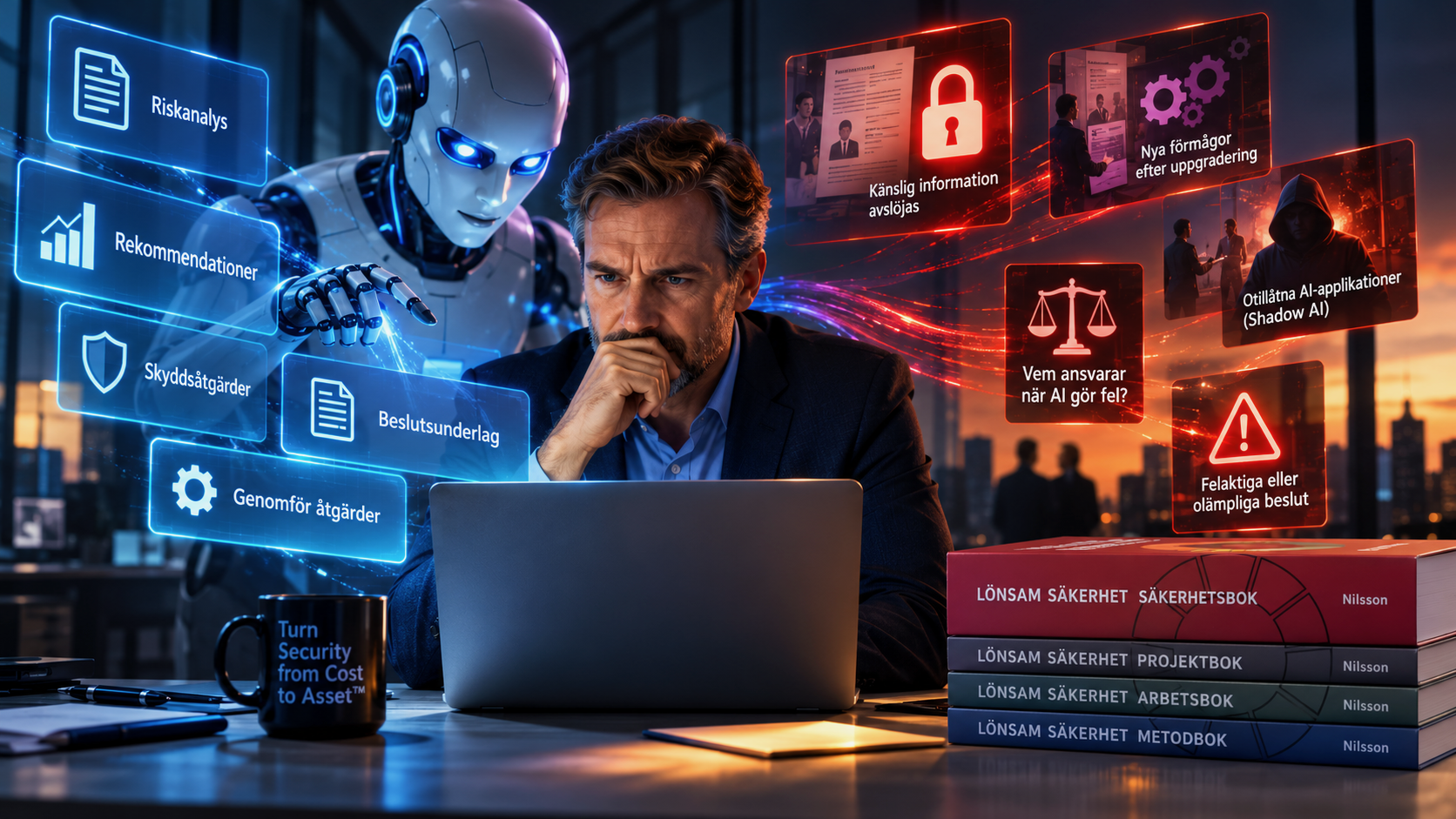
AI can improve efficiency, but without sufficient knowledge and oversight, the technology can also amplify the consequences of mistakes.
AI assistants and AI agents are rapidly becoming an integral part of how organizations operate. They are used to compile information, analyze risks, recommend measures, prepare documents and support decision-making. An increasing number of AI applications can also perform tasks autonomously and take actions in other systems.
These developments create significant opportunities, but also introduce new security risks. Employees can use AI to perform tasks that exceed their own expertise. The results may appear professional and convincing, even when they are based on incorrect assumptions or lead to inappropriate decisions.
There is a particular paradox here. Those responsible for protecting an organization can themselves become a source of security risk if they use AI without understanding its limitations.
Knowing how to use AI is not the same as having the competence to perform the underlying task.
When AI Becomes a Security Risk
In my previous article Are You Managing Security, or Is It Just an Illusion?, I described how security managers risk becoming dependent on AI to compensate for gaps in their own expertise. But the problem extends beyond that. A lack of competence in using AI not only increases the risk that security professionals will be replaced by AI-powered systems. It can also create serious security risks for the organization.
AI can produce risk analyses, decision-making materials and recommendations based on incorrect information, misunderstandings or incomplete assessments. AI operates on digital information, while humans interact with the physical and social world, where important circumstances may never have been documented. Human expertise is therefore essential for providing the context and information that AI lacks. It is equally important for determining which information is relevant and whether AI-generated conclusions are valid. Without this expertise, decisions may weaken security rather than improve it.
Unfortunately, ignorance is a blind spot we cannot recognize until we know better.
The risks become even greater when AI systems are authorized to take actions autonomously. An AI agent with access to organizational documents, emails, databases and administrative systems can cause far more damage than an assistant that merely provides recommendations. Incorrect instructions, manipulated information or excessive permissions can result in sensitive information being disclosed, altered or deleted. The challenge therefore goes beyond verifying the quality of AI-generated responses. Organizations must also understand what authority these systems have and the potential consequences of incorrect actions.
The greater the autonomy granted to AI, the higher the demands on user competence and organizational security measures.
When an Approved AI Application Changes
Another challenge is that AI applications are evolving at a pace that can make traditional security reviews insufficient. When a new IT system is introduced, organizations typically assess its functionality, information handling, access permissions and associated risks before approving it for use. Once approved, the system is often expected to continue operating largely as before until a significant change is introduced. With AI, however, these conditions can change much more rapidly.
An AI application that only summarizes documents today may, following an update, gain the ability to search databases, manage emails, access external services or perform tasks autonomously. New features, integrations and models can change information flows, access permissions and system behavior. An application that has previously been reviewed and approved may therefore acquire entirely new capabilities and vulnerabilities without the organization recognizing the change.
An AI application that was secure when first approved is not necessarily secure today.
Organizations must therefore continuously monitor which functions are enabled, what changes suppliers introduce and how these changes affect their security risks. New capabilities must be assessed before they are granted access to sensitive information or business-critical functions. This becomes particularly important when AI agents can act autonomously. An update that expands a system's capabilities may also increase the potential consequences of an error.
Unapproved AI Applications
While organizations are working to maintain control over their approved AI systems, employees may be using their own applications and services. This is commonly referred to as Shadow AI, a form of shadow IT in which AI tools are used outside the organization's approved and controlled IT environment.
It may begin with someone uploading a document for summarization, allowing an AI service to analyze customer data or connecting a personal AI assistant to their email, calendar or cloud storage. The intention is often to work faster and more efficiently. However, information may leave the organization's controlled environment and be processed by external services over which the organization has little or no oversight. Depending on how these services operate, sensitive information may be stored, shared or used in ways the organization has never authorized.
If such an application also gains access to internal systems, it may introduce new attack vectors and vulnerabilities. The organization may not even be aware that the connection exists.
You cannot effectively protect information if you do not know where it is stored or who has access to it.
Restrictions and policies may be necessary, but organizations also need to provide approved alternatives that allow employees to benefit from AI technology. Otherwise, employees may continue using unauthorized services beyond the organization's oversight and control.
Who Is Responsible When AI Goes Wrong?
When a person makes an incorrect decision, responsibility is normally divided between the employee, their manager and the organization. However, when an AI agent recommends, makes or executes decisions, it can become more difficult to determine who actually controlled the process. An employee may have approved an action without understanding its consequences. An AI agent may have acted within its technical permissions but beyond what the organization intended. A supplier may have changed the system's functionality without users being aware of the changes.
The consequences may affect the organization, its customers, employees or other stakeholders. However, AI cannot itself be held personally accountable for its actions. Legal and organizational responsibilities must therefore be addressed by the people and organizations that develop, provide and use the technology. It must be clear who has the authority to introduce AI applications, approve access permissions, enable new functions and delegate tasks to AI systems. The organization must also be able to trace the actions performed by AI, stop inappropriate actions and restore information or systems when something goes wrong.
Tasks can be delegated to AI, but accountability remains with the people and organizations responsible for its use.
Do We Need an AI Driving Licence?
We do not allow people to drive vehicles, operate heavy machinery or perform other hazardous tasks without appropriate training and qualifications. Anyone operating such equipment must understand how it works, the risks involved and the potential consequences of mistakes. Yet an employee may use AI to analyze sensitive information, assess security risks and recommend decisions with far-reaching consequences without having sufficient knowledge of either the technology or the underlying task.
At the time of writing, there is no universal requirement for an AI driving licence. But perhaps that is precisely what we need. In the early 1990s, the European Computer Driving Licence (ECDL) was introduced.
A similar qualification for AI could establish a basic understanding of the technology's capabilities, limitations, information handling, access permissions, risks and responsibilities. Different applications could require different levels of competence, just as driving a heavy goods vehicle requires more extensive qualifications than driving a passenger car.
However, an AI driving licence would only be the beginning. Understanding how to use the technology is not enough. Anyone using AI to perform security-related tasks must also possess sufficient professional expertise to evaluate the work and its potential consequences. AI training and certification programmes are already available through the Swedish Computer Society (Dataföreningen).
Learning how to write prompts for an AI assistant does not make someone a security expert, any more than searching for medical information makes someone a doctor.
Knowledge Determines Whether AI Improves Security or Creates New Risks
AI can improve efficiency, but without sufficient knowledge and effective security measures, the technology can also amplify financial losses and other harmful consequences. Anyone using or responsible for AI must therefore understand the organization, its objectives and assets, the threat landscape, the potential consequences of incidents and the protective measures required.
This comprehensive understanding makes it possible to assess whether AI-generated recommendations are relevant, whether proposed measures will be effective and whether they contribute to organizational efficiency and profitability. For security managers, this creates clear professional competence requirements. They must be able to understand and evaluate security-related findings even when analyses, documentation and decision-making materials have been produced with AI assistance. They must also be capable of assessing the new risks that AI introduces to the organization.
For more than two decades, I have developed a systematic approach to improving the effectiveness, efficiency and profitability of security management. The result is the Profitable Security book series, which brings together organizational assets, threats, consequences, protective methods, organizational structures, effectiveness, efficiency and investments into a coherent framework for managing, measuring and evaluating security activities.
The book series provides a comprehensive knowledge base for the next generation of security managers, enabling them to use AI as a powerful tool while retaining the knowledge and capabilities needed to understand their organizations and make informed decisions.
AI can help you perform security tasks. But your own knowledge determines whether those activities actually improve security.
Turn Security from Cost to Asset™
#Skydd2026 #ProfitableSecurity