AI, careers and economic value
Are You a Profitable Employee?
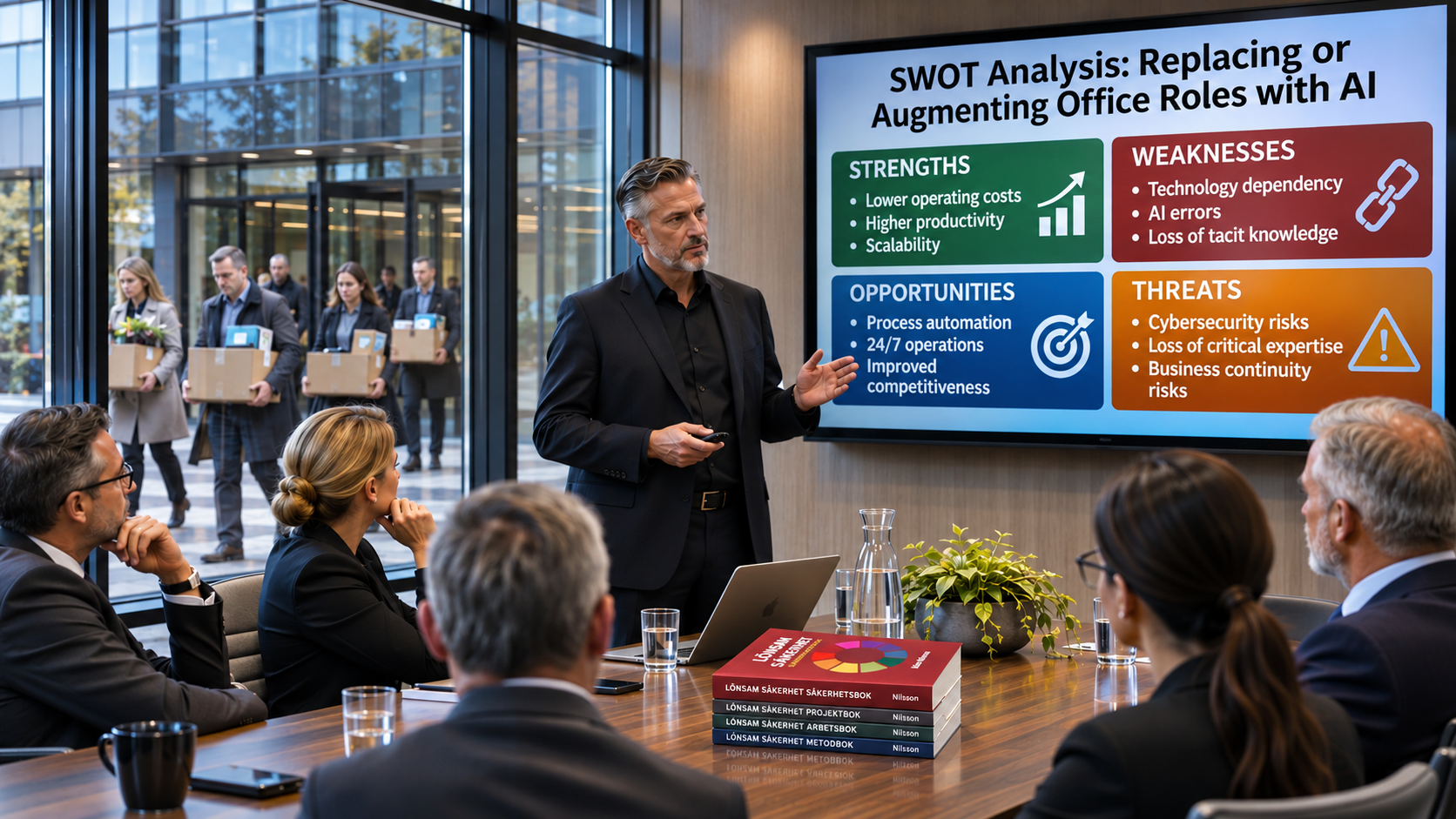
Demonstrating your economic value in an increasingly automated workplace
I frequently see people on LinkedIn announcing that they are looking for new employment opportunities. They describe their education, previous positions, professional experience and personal qualities. They are dedicated, motivated, experienced leaders and excellent team players. These qualities have value. But something important is often missing.
How have you contributed to your previous employers' financial performance?
Have you increased revenue, reduced operating costs, prevented losses or enabled new business opportunities?
What economic value can you create for your next employer?
These questions are becoming increasingly important as artificial intelligence transforms the labour market.
The Security Manager as a Trusted Adviser
A security manager acting as a trusted adviser to senior management must understand the entire business. That includes its business model, financial performance, strategic objectives, organisational structure and competitive position. Security is not an isolated activity. Its purpose is to protect and support the organisation's ability to achieve its objectives.
AI-driven rationalisation is set to become one of the most significant organisational changes of the coming years. It will affect operating costs, productivity, staffing levels, business processes and the way organisations compete. It will also change the organisation's dependencies, vulnerabilities and risk exposure.
Security managers must understand these developments and participate in the strategic decisions that shape them. That is what being a trusted adviser requires.
From Industrial Robots to Artificial Intelligence
Companies have always sought ways to improve productivity and competitiveness.
Scania, the Swedish truck manufacturer, provides a useful historical example. During the post-war industrial expansion, the company recruited workers from countries including Italy and Finland to meet growing demand. In the following decades, automation and industrial robots transformed its manufacturing operations. In September 2025, Scania announced restructuring plans affecting 750 positions, including approximately 400 within Human Resources. AI was not the stated reason for the restructuring, but the company anticipated further automation of administrative tasks.
Today, AI is extending automation beyond physical production into intellectual and administrative work. This represents a fundamental change in how organisations can use human resources.
The Economic Reality of AI
In most organisations, personnel expenses represent the largest operating cost, particularly in labour-intensive businesses. AI offers opportunities to perform tasks faster, improve productivity and reduce operating costs. Some companies will increase their output with existing employees. Others will reduce staffing requirements.
I am not particularly enthusiastic about the prospect of large numbers of people losing their jobs because of technology. However, my personal preferences will have no influence on how this development unfolds.
The primary driving force is profitability and competitiveness.
Companies are investing in AI to improve their financial performance and strengthen their position in the market. Adopting AI is a management decision. However, no company can decide whether its competitors will adopt the same technology. When competitors deliver comparable products or services at lower costs, with greater productivity or better quality, companies that fail to adapt risk losing their competitive position.
Reducing the workforce through automation will put some jobs at risk. But if a company loses its competitiveness and is eventually forced out of business, every employee will lose their job. Management must therefore balance the immediate consequences of rationalisation against the long-term survival of the business.
Maintaining existing staffing levels may protect jobs in the short term. Improving productivity and competitiveness may be necessary to preserve the organisation and its remaining jobs.
The choice is not always between protecting jobs and eliminating them. It may be between adapting in time and losing the business altogether.
The Race for AI Creates New Risks
The economic incentives to adopt AI are considerable, and competition is driving rapid implementation. Unfortunately, security and risk management are not always keeping pace. An IBM study published in June 2026 found that 77% of surveyed organisations reported AI adoption was already outpacing their governance capabilities. As organisations introduce AI into business-critical processes, they become increasingly dependent on technology providers, cloud services, digital infrastructure and the availability and integrity of information.
Rationalisation can also eliminate valuable human capabilities. Experienced employees leave, undocumented knowledge disappears and organisations may lose the ability to perform essential tasks manually. These changes affect business continuity and operational resilience.
A company may reduce annual operating costs by millions through automation, only to lose those savings through a serious business interruption, information breach or incorrect automated decision.
The economic value of automation must be assessed against its total cost, including vulnerabilities, risks and potential consequences.
Security managers have a responsibility to contribute to these assessments. Their role is to help management implement changes that improve competitiveness without exposing the organisation to unacceptable risks. A profitable rationalisation must remain profitable when the risks are taken into account.
Is Your Business Function Profitable?
Every business function consumes resources and is expected to contribute to the organisation's objectives. Security, HR, finance, marketing, administration and other functions must be able to demonstrate the value they create.
What does your function cost?
What results does it deliver?
How does it contribute to revenue, profitability, operational efficiency or business continuity?
Can the same results be achieved at a lower cost through improved processes, organisational changes or technology?
Can AI increase productivity? Can certain activities be automated entirely?
These are fundamental management questions. A function may create substantial value while still operating inefficiently.
The objective is not to minimise expenditure. It is to maximise the value created by the resources invested.
That principle applies to the entire organisation, its functions and its employees.
Four Ways to Demonstrate Economic Value
In my book series Profitable Security (Lönsam säkerhet), I explain how security contributes to financial performance and how that contribution can be identified, measured and evaluated. The same economic principles apply to business functions and individual employees. There are four principal ways to create economic value.
1. Increase Revenue. Demonstrate how your work has contributed to increased sales, improved customer retention, higher production capacity or new business opportunities.
2. Reduce Operating Costs. Show how you have improved productivity, reduced resource consumption, shortened processing times or made operations more efficient.
3. Prevent Losses. Document how your work has prevented or reduced errors, incidents, accidents, business interruptions, customer complaints and other costly consequences.
4. Enable Business Opportunities. Explain how your competence has enabled the organisation to meet customer requirements, fulfil contractual obligations, obtain certifications or enter new markets.
Not all these contributions appear directly in financial reports. A skilled maintenance technician who prevents a week of production downtime can create substantial economic value without generating a single sales invoice. A security manager whose work enables a company to qualify for a major customer contract can create value far exceeding the cost of the security function.
Economic value is not limited to generating revenue. Preventing losses and enabling business can be just as important.
The challenge is to identify, measure and communicate that value.
Document Your Profitability Before Someone Else Evaluates It
Employees and job seekers need to understand and document the economic value they create.
Start now. Do not wait until you face redundancy or need to prepare for a job interview.
Review the results of your work over the past few years.
Identify the improvements you have contributed to, the problems you have prevented, the costs you have reduced and the business opportunities you have enabled.
Use financial figures whenever possible. When exact amounts are unavailable, use relevant performance indicators, documented improvements or clearly identified estimates.
Describe your own contribution accurately, particularly when results were achieved through teamwork.
Consider these two fictional presentations.
"I am an experienced manager with strong leadership skills and a proven ability to develop successful teams."
Compared with:
"I led a team that reduced operating costs by 15%, improved delivery performance and reduced employee turnover over three years."
The second presentation provides an employer with concrete results that can be evaluated. It demonstrates economic value rather than simply listing personal qualities and professional experience. You must also understand how technology affects your work. Identify which tasks can be automated, where AI can improve your productivity and which aspects of your competence remain essential. Learn to use technology to increase your contribution. A professional who combines experience, judgement and relevant technology can become more valuable to an organisation.
At the same time, understand that economic value includes more than immediate cost savings. Quality, trust, judgement, relationships, continuity and the ability to handle unexpected situations can have substantial long-term financial significance. Document these contributions as well.
Prepare for the Future
AI-driven rationalisation will fundamentally change how many organisations operate. Some jobs will disappear, others will change and new opportunities will emerge. The extent and pace will differ between industries, but the economic pressure to improve productivity and competitiveness is already here.
Security managers must understand these changes and their consequences for the organisation.
Business functions must demonstrate how they contribute to financial performance and strategic objectives.
Employees and job seekers must identify, develop and communicate the economic value they create.
Your education, experience and personal qualities are resources. What matters to an employer is the value you can create with those resources. Ask yourself three questions.
Are you part of a profitable business function?
Are you a profitable employee?
Can technology increase your economic contribution, or could your work be performed just as well without you?
Do not wait for someone else to answer these questions on your behalf. Understand your value, document your results and prepare for the future.
Learn More About Profitable Security
The Profitable Security (Lönsam säkerhet) book series explains how security can be transformed from a necessary expense into a measurable contribution to an organisation's profitability. The books provide a practical, structured methodology for analysing assets, threats, consequences, protective measures, organisational effectiveness, investments and economic results.
Although developed for security management, the principles can also be applied to broader business decisions, organisational development and resource management.
Learn more about the book series at https://profitablesecurity.com
Klas Nilsson, CPP, PSP, PCI, CISM, CFE
Turn Security from Cost to Asset.