AI, competence and preparedness
As Technology Becomes Smarter, What Happens to Our Own Capabilities?
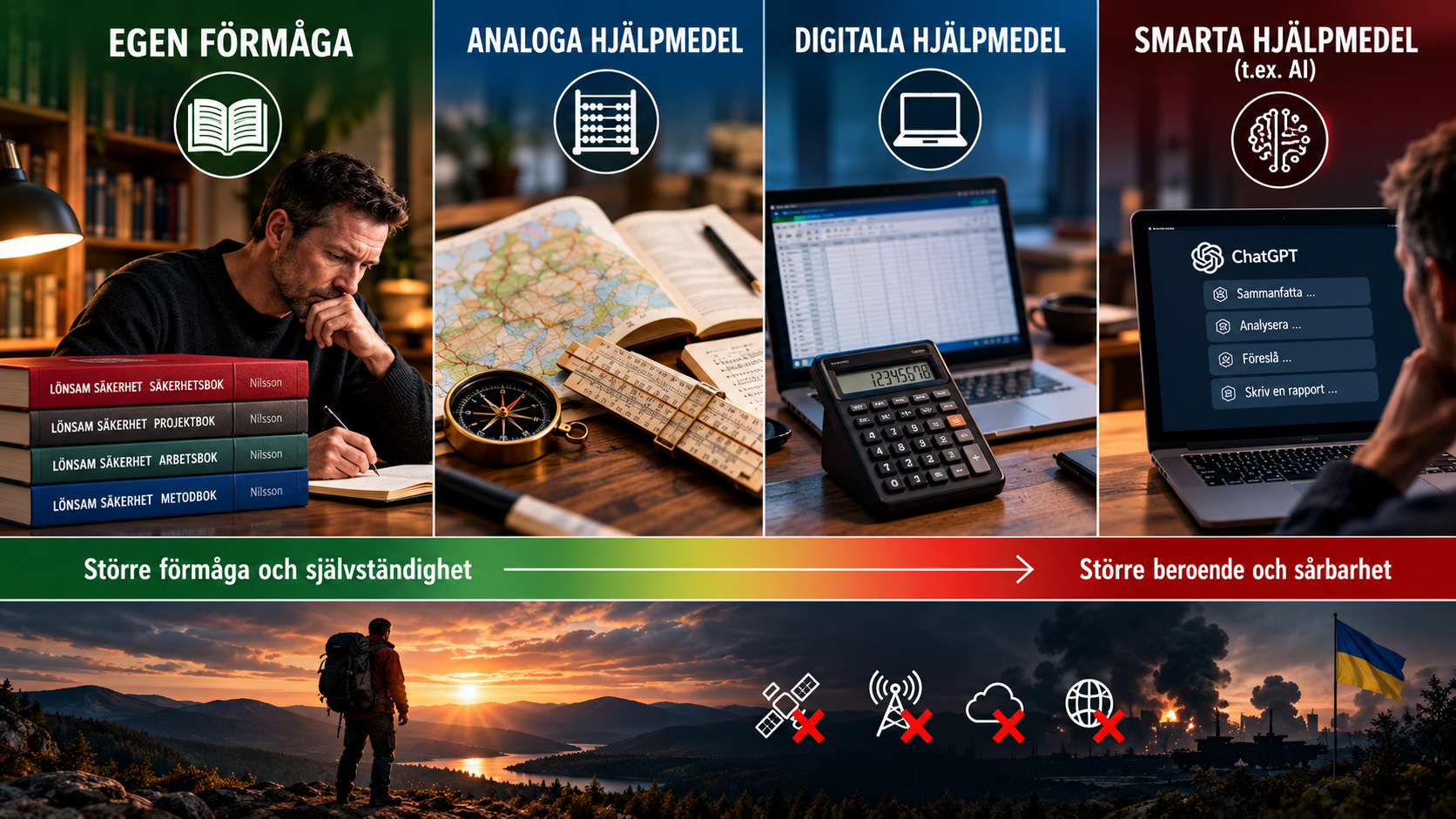
Never before have we had such easy access to information. With the help of artificial intelligence, we can get answers in seconds to questions that once required hours of research. AI can summarize extensive reports, perform analyses, suggest solutions and support decision-making.
But this raises an important question: Are we becoming more capable as our tools become smarter, or are we simply becoming more dependent on them?
For a long time, I have been reflecting on how technology affects our ability to solve problems. This question is relevant not only to our everyday lives but also to organizational security and preparedness.
A simple example is how we remember telephone numbers. Thirty years ago, many of us knew several numbers by heart. Today, we barely need to remember our own. Our phones store the numbers for us, and we rarely need to rely on our memory. This phenomenon is often referred to as digital amnesia, the tendency to remember information less readily when we know it is available digitally. This is convenient and efficient, but it also illustrates how technology can change our habits and abilities. We have gained easier access to information while becoming increasingly dependent on technology to retrieve it.
Recently, I watched two interesting interviews with David Krakauer, an evolutionary biologist and researcher in complex systems at the Santa Fe Institute. His research includes intelligence, learning and how the tools we use influence our cognitive abilities. His observations articulate something I have been thinking about for a long time.
Tools That Develop or Replace Our Skills
Krakauer distinguishes between two types of cognitive tools: complementary and competitive.
Complementary (analog) tools help us perform tasks while also contributing to the development of our own skills. An abacus is an interesting example. It helps us perform calculations, but learning to use it also develops our mathematical abilities. Research cited by Krakauer shows that people trained to use an abacus can learn to perform calculations mentally, eventually without needing the tool itself. A map works in a similar way. By reading a map and comparing it with the terrain, we develop our navigation skills and understanding of our surroundings.
Competitive (digital and intelligent) tools work differently. They perform tasks for us without necessarily developing our corresponding skills. A GPS device can guide us to our destination without requiring us to understand how to navigate independently.
A calculator can perform complex calculations without requiring us to understand the mathematics behind the results. An AI assistant can conduct analyses and suggest solutions without us having to master the underlying methods ourselves. Both types of tools increase our capabilities, but they do not necessarily develop our own skills in the same way.
When We Leave the Thinking to Technology
In one of the interviews, Krakauer compares the brain to our muscles. If we leave all the thinking to someone else, our own cognitive abilities may weaken. The analogy with physical exercise is appropriate. We do not become stronger by having someone else work out at the gym for us. Similarly, we do not necessarily improve our ability to analyze problems by allowing an AI assistant to do all the work.
But Krakauer also raises a deeper question. We do not yet fully understand how the use of digital and intelligent tools affects the development of our thinking over time. When we learn to perform a task, we often develop additional abilities beyond those required for the task itself. Learning to calculate using a slide rule, for example, can develop our mathematical intuition and understanding of relationships. How might our thinking in other areas be affected when we no longer need to develop these skills?
Krakauer also points out that if a technological tool performs a particular task better than a human, there may be little immediate incentive to learn the skill ourselves, provided the tool is always available. This is where I find the argument particularly interesting from a security and preparedness perspective.
What happens when the tool is no longer available?
When Someone Else Controls Our Capabilities
We are becoming increasingly dependent on digital services, communication systems and technology platforms that we neither own nor control. This creates vulnerabilities that may remain unnoticed as long as the systems continue to function.
A recent example is Ukraine's reliance on the Starlink and Starshield satellite communication systems. In October 2026, the functionality of these systems was restricted. This affected, among other things, the use of drones to counter Russian attacks. The incident illustrated how quickly a critical capability can be affected by decisions and changes beyond an organization's control. Most importantly, a capability on which Ukraine had based parts of its defense could be restricted by an external provider.
The same principle applies to businesses, government agencies and organizations providing essential services that depend on external cloud services, communication systems and AI platforms. We may have access to highly advanced technology while having limited control over its continued availability.
A capability that depends entirely on someone else's technology also depends on their decisions.
Efficiency and Preparedness Must Be Developed Together
Technology can make us faster, more efficient and more productive. This is fundamentally positive. However, an organization that eliminates its own expertise in pursuit of efficiency may also lose its ability to manage disruptions. For example, a security manager can use AI to prepare a risk analysis. This can save considerable time and help identify connections that might otherwise be difficult to recognize. However, the security manager must still understand the principles of risk analysis, be able to assess whether the conclusions are reasonable and make decisions based on the organization's specific circumstances. Otherwise, there is a risk that AI-generated assessments will be accepted without sufficient scrutiny.
There are therefore two important reasons to maintain and develop our own expertise.
The first is that we must be able to assess whether the results produced by technological tools are accurate and useful.
The second is that we need to retain the ability to perform at least the most critical tasks when those tools are unavailable.
We do not need to be as fast or as efficient as technology. What matters is having sufficient knowledge and skills to continue operating independently when necessary. This is a fundamental part of organizational preparedness and resilience.
Why We Still Need to Read Books
This brings me to something I believe has become increasingly important as AI continues to advance: the value of reading books.
AI can generate text far faster than we humans can read, process and understand it. We can receive extensive analyses, summaries and recommendations in seconds, but that does not mean we have acquired the knowledge behind them. Furthermore, we often consume this information on the same screen where messages, notifications and other tasks compete for our attention.
When we read a well-written specialist book, we have the opportunity to follow a coherent line of reasoning at our own pace. We can pause, reflect on the content and connect it to our existing knowledge and experience. In this way, we develop an understanding of how different elements relate to one another, why methods work and how knowledge can be applied in new situations. A physical book also allows us to concentrate on a subject without the digital interruptions that can otherwise disrupt our thinking. Reading becomes an active process in which we process information, question arguments and draw our own conclusions. This is particularly valuable when dealing with complex issues that require analysis, judgment and understanding.
In security and preparedness, this is essential. We must be able to understand relationships, assess consequences and make well-informed decisions even when information is incomplete or circumstances change rapidly. These abilities develop through knowledge, experience, reflection and practical application.
This does not mean that AI is a poor learning tool. On the contrary, AI can be an excellent complement to books, education and practical exercises. However, there is a fundamental difference between using AI to develop our own understanding and using AI to avoid the effort of understanding.
Getting an answer is not the same as understanding it. And having access to knowledge is not the same as possessing that knowledge ourselves.
Knowledge Builds Capability
For many years, I have worked on developing methods to make security management more effective, efficient and profitable. A central principle of my work is that security is about developing an organization's capability to protect its assets, manage risks and maintain operations even during disruptions. This is also why I wrote the Profitable Security book series.
The books provide methods, principles, practical procedures and examples that help readers develop their own knowledge and skills in security and preparedness. The aim is to equip readers with the knowledge and understanding needed to independently analyze problems, evaluate alternatives and make well-informed decisions. I use AI myself and recognize the tremendous potential of this technology. At the same time, I firmly believe that we must continue developing our own knowledge, understanding and problem-solving skills. This applies to both individuals and organizations.
Because when technology fails, communications break down or an external provider restricts access to a service, it is our own knowledge and capabilities that determine what we can still accomplish.
By all means, use intelligent tools. But keep reading, thinking, practicing and developing your own capabilities.
No one can switch off the knowledge you have acquired yourself at the push of a button.
References and further reading
David Krakauer on StarTalk: Why We Haven't Reached Superintelligence.
David Krakauer: Can Outsourcing Thinking Make Us Dumber?
Reuters, 14-25 October 2026: Reporting on restrictions and restoration of Starlink and Starshield in Ukraine.
Profitable Security – Method Book, Workbook, Project Book and Security Book. Read about the books.